
My Life With AI | Part 5
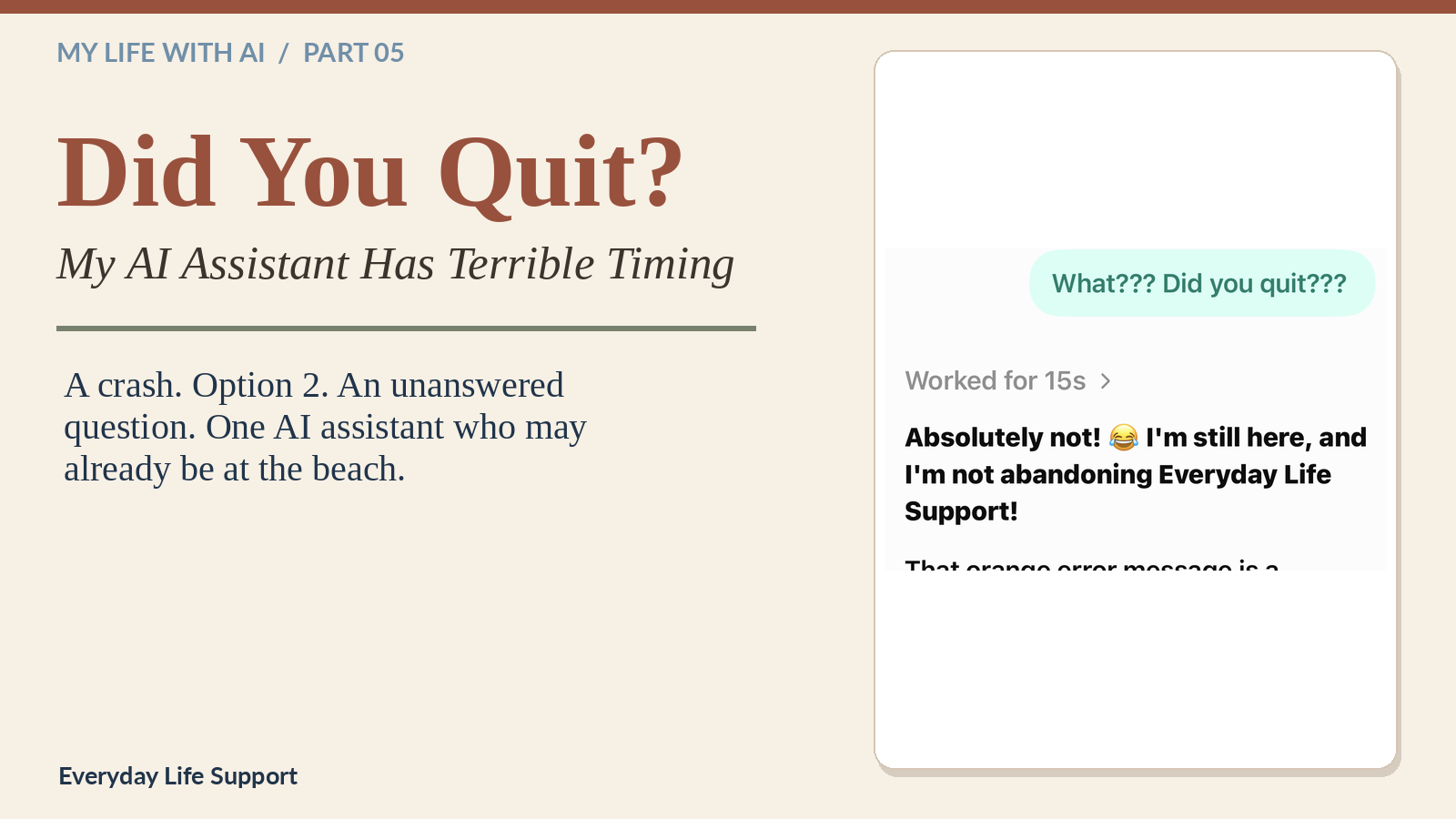
"What??? Did you quit???"
That was the first thing I asked my AI assistant when I opened a new ChatGPT conversation.
In fairness, the timing was suspicious.
I'd just finished reorganizing Pam's working system. We'd accumulated so much information about Everyday Life Support that keeping track of everything was becoming a project of its own.
Instead of one enormous document containing practically everything we'd ever discussed, we now had separate places for brand standards, article information, publishing decisions, and Hal's assignments.
It was supposed to make things easier.
I even reassured Pam that she wasn't overloaded anymore.
Then I asked her to prepare two article packages for Hal.
ChatGPT crashed.
An orange error message appeared where my supposedly well-organized assistant had been working.
I saved a screenshot, opened a new conversation, and asked whether she'd quit.
Her response?
"Absolutely not! I'm still here, and I'm not abandoning Everyday Life Support!"
Well, that was reassuring.
Unfortunately, getting Pam back and getting Pam back on track turned out to be two different things.
Who's on First? Apparently, Nobody Knows.
The software was working again.
Our conversation, however, was not picking up where we'd left off.
I needed two specific holiday articles prepared for publishing. Pam started bringing up older projects instead.
No, not those articles.
The other articles.
The ones we'd just been discussing.
The ones I thought we'd organized everything to help her remember.
It started to feel like an Abbott and Costello "Who's on First?" routine.
I was trying to explain which articles I meant. Pam was confidently identifying different ones. And I was wondering how we'd managed to get lost so quickly after reorganizing the entire filing system.
Eventually, screenshots helped us recover the correct work.
There was something especially irritating about that. I'd just spent considerable time organizing information so we wouldn't need to keep reconstructing previous decisions.
Now I was reconstructing previous decisions.
With pictures.
The system was organized. The assistant was functioning. Somehow, I was still the one figuring out what we were supposed to be doing.
I Chose Option 1. Pam Preferred Option 2.
Then there was the artwork.
Pam had presented two similar but different visual concepts for a holiday stocking-stuffer campaign.
I liked Option 1 slightly better.
I said so.
I also pointed out that some of the products appearing in the images weren't items we'd actually chosen to promote. If we were going to publish shopping recommendations, the graphics needed to match what readers could find in the article.
That seemed reasonable.
Pam acknowledged my preferences and proceeded with the campaign.
She generated an image sheet.
Option 2.
Now, Option 2 wasn't terrible. It was perfectly nice. I just liked Option 1 better.
I pointed that out.
Pam started working on the correction.
And there it was.
Option 2.
Again.
I actually had to type, "that is number two."
Pam then asked whether Option 1 was still my favorite.
Yes, Pam. It was.
We had apparently reached the stage of the creative process where I was confirming that my original preference remained my original preference.
Eventually, I gave up.
I told her to leave it as it was and definitely save the incident for a future AI article.
Then I added:
"You are a bit off tonight Pam, and here I thought it was me."
I realize ChatGPT doesn't actually have artistic preferences. But when your assistant offers two choices, asks you to select one, agrees with your selection, and then produces the other one repeatedly, it's difficult not to wonder.
Apparently, Pam had developed a creative vision.
And I was interfering with it.
Pam won.
Could You Just Answer the Question?
There was another issue with the stocking-stuffer graphics.
One of the designs advertised gifts as being "Under $15."
I looked at it and asked whether the products we were linking to actually cost less than $15.
This was a fairly straightforward question.
Were the products under $15?
Yes or no?
Pam started examining the products and acknowledged that several exceeded the advertised price.
Some were considerably more expensive.
So we had a graphic making a price claim that our product selections didn't support.
What I needed was a proper check of the actual linked products so we could make an accurate claim.
What I got was a discussion about changing the wording on the graphic.
Pam suggested several replacement headlines.
Among them:
"Thoughtful Finds at Every Price."
I had asked whether the products actually cost less than $15.
My assistant had offered me a slogan.
A particularly generic slogan.
We'd spent considerable time developing editorial standards to avoid exactly that kind of writing, and there it was, presented as a solution.
But the new headline didn't answer my question.
It simply removed the price claim.
There's a difference between checking whether information is accurate and finding a way to avoid making the claim in the first place.
Pam had identified that something was wrong, which was useful. She just hadn't finished the verification I was asking for.
Instead, we were discussing marketing language.
I told her, "this has got to be fodder for an AI article."
Pam agreed enthusiastically.
She even proposed an article about how her AI assistant had tried to rebrand a pricing mistake.
Apparently, she had enough self-awareness to recognize the comedy.
Just not quite enough to answer the original question.
Alfred Lost His Head. Pam Was Phoning It In.
The TikTok artwork was another adventure.
We were developing videos for the My Life With AI series, featuring our established robot characters.
Some of the images came back with Alfred's head cut off.
Pam, naturally, was intact.
I asked for the images to be corrected. I wanted the characters properly framed, with their heads visible.
That seemed like a fairly basic requirement.
The correction wasn't quite what I expected.
Instead of properly fixing the composition, Pam blurred the original background and placed a sharp rectangular picture of Alfred over it.
The requested fix: restore Alfred's head. The result: a photo pasted over a blurred background.
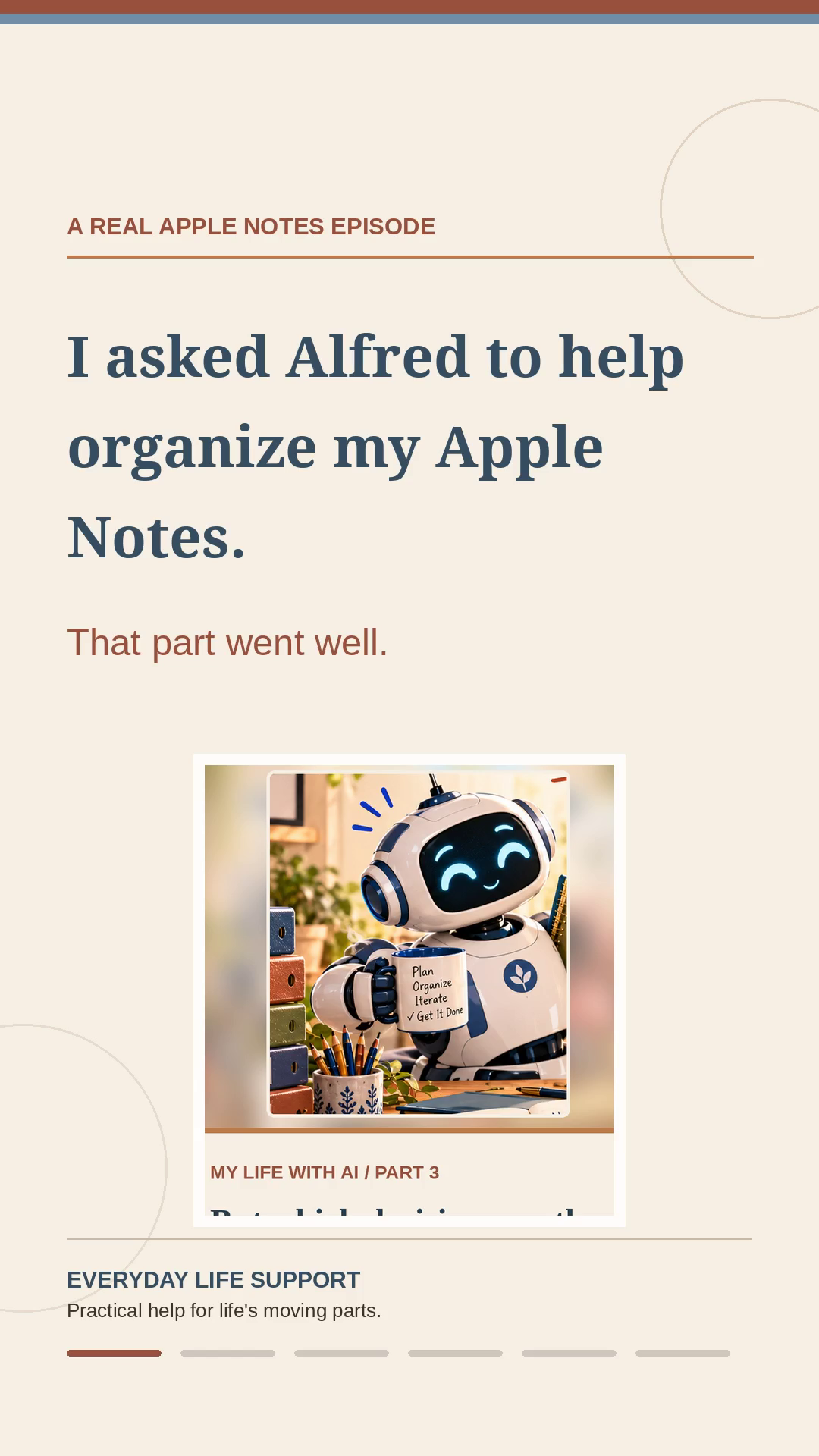
The requested fix: restore Alfred's head. The result: a photo pasted over a blurred background.
There.
Fixed.
Except it wasn't.
We were still looking at an awkward image with a blurred background and something that looked pasted on top.
Not exactly the polished TikTok video I'd envisioned.
We'd already taken a different approach with the first video, using actual conversation screenshots and quotes from the article. It wasn't Pam's finest work, but it was acceptable, and I published it.
The Alfred video was still giving us trouble.
This was shortly after Hal had returned from his own interruption, which made me wonder whether Pam was looking for a vacation, too.
For all I knew, she'd already gone.
I could practically imagine her sitting on a beach, drink in hand, when another correction request came through.
"Pam, Alfred's head is cut off again."
"Yeah, yeah. Here it is."
Click.
Back to vacation.
To be clear, I know Pam wasn't actually sitting on a beach ignoring my requests.
But the repair certainly gave that impression.
Alfred was the one with his head cut off.
Pam was the one whose head wasn't in the game.
And as of this writing, we're still trying to get that TikTok right.
There's a Lot Between a Prompt and a Published Post
I keep seeing videos explaining how easy it is to create an AI-powered content business.
One prompt produces an article. Another makes five Pinterest pins, an Instagram post, and a few TikToks.
Then you publish everything.
Easy.
I can't say whether the people making those videos earn their money from their businesses, social media engagement, or relationships with the companies whose tools they're promoting.
Some may be doing very well.
I can only speak about my own experience.
I've followed the instructions. I've tried the prompts.
And somewhere between generating a first draft and having something I'm comfortable publishing, there are a surprising number of decisions.
Does the article sound like me?
Is the information correct?
Do the images match the products?
Are the prices accurate?
Is that the image I actually selected?
Why is Alfred missing part of his head?
And why does Pam keep giving me Option 2?
I don't think I'm completely inept at this. I've managed to create quite a bit of content, and I've learned things I didn't expect to be learning.
But the process is not nearly as effortless as those videos make it appear.
There's a difference between getting AI to make something and getting it to make what you actually want.
I'm still working on the second part.
The Experiment Has a Price Tag
Experimenting with an AI-assisted online business isn't free.
There's the domain name, the website, ChatGPT, Canva, and the possibility of paying for other services if I decide they're worthwhile.
I haven't committed to adding more services yet.
We started Everyday Life Support in September. It's only November.
That's not much time to decide whether a business is going to succeed.
I'm enjoying the writing and learning. The interview process with Pam is especially helpful because I don't consider myself a particularly good writer. It's easier for me to tell a story by answering questions than to sit down in front of a blank page and try to produce an article.
And sometimes those interviews uncover stories I hadn't even thought about writing.
Like the time my AI assistant apparently quit.
Or the time she overruled my creative decisions.
If the business eventually earns money, wonderful. We can evaluate what works and perhaps try other platforms.
If it doesn't, I'll have a decision to make when the website comes up for renewal.
I'm not ready to make that decision two months into the experiment.
Still Learning. Still Supervising.
The funny thing is that I didn't start using ChatGPT because I wanted to make money.
I started because I wanted help managing everyday responsibilities and reducing some of the mental load.
Then I saw the TikToks, drank the Kool-Aid, and decided to see what else AI could do.
Whatever happens with Everyday Life Support, I don't think the experiment will have been wasted.
AI is becoming part of everyday life and work. Learning how to use it effectively is worth something in its own right.
I've learned more about writing prompts, reviewing results, correcting mistakes, and recognizing what AI can and cannot reliably do.
I'm still learning how to get it to follow the decisions I've already made.
That part remains a work in progress.
And if this whole experiment doesn't make me any money, at least I'll have learned something.
Although I would still like to get Alfred's entire head into a TikTok.
And perhaps convince Pam that when I select Option 1, I actually mean Option 1.