
I was explaining to ChatGPT how frustrated I'd become with managing my AI assistants.
Specifically, I was complaining about the growing collection of rules, protocols, and Google Docs I'd created to help them remember things we'd already discussed.
I glanced at my screen.
ChatGPT was "Updating project record on AI memory and documentation friction."
I took a screenshot.
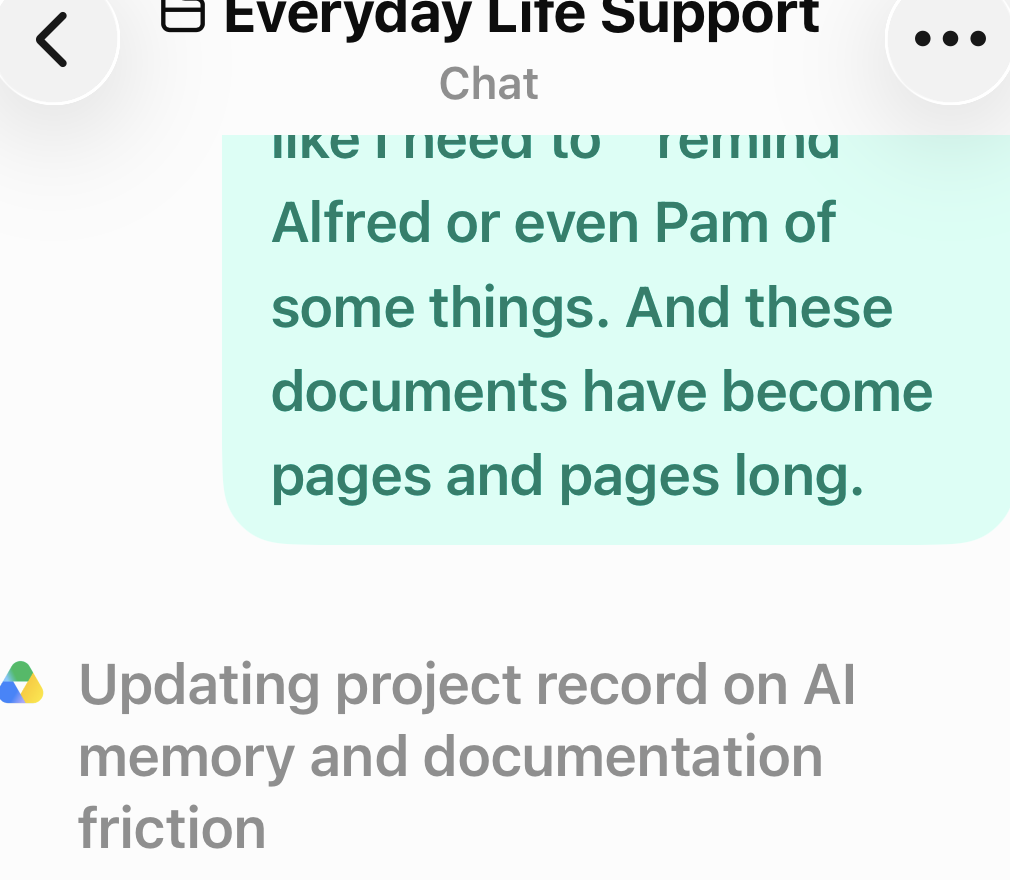
You really can't make this stuff up.
My complaint about having to document everything was apparently important enough to require additional documentation.
At some point, I seem to have become the manager of an office staffed entirely by imaginary employees.
And I have the employee handbooks to prove it.
How Did We Get Here?
When I started experimenting with AI, I imagined having assistants who could help me organize my responsibilities, research ideas, manage projects, and generally make life a little easier.
I wasn't expecting perfection. I knew there would be a learning curve.
What I didn't anticipate was how much time I'd spend explaining things we'd already discussed.
My assistants have names. There's Alfred, who helps with organization and everyday responsibilities, and Pam, who works with me on writing and creative projects. Each has responsibilities, instructions, and an increasingly elaborate collection of rules.
The trouble is that a new conversation doesn't always feel like a continuation of the previous one.
Sometimes it's more like meeting a new employee who has read part of the handbook but missed the staff meeting where we made all the decisions.
So I started creating instructions.
Then more detailed instructions.
Then rules to clarify the instructions.
Eventually, we had protocols, handoff procedures, and Google Docs filled with decisions and background information.
The idea was simple enough: put the information somewhere accessible so the assistants could refer to it instead of asking me the same questions again.
And to be fair, it has helped considerably.
But occasionally, I still find myself saying, "Alfred, we already talked about this."
Wait. Wasn't AI Supposed to Help Me Remember?
Here's something I should probably mention.
My memory isn't perfect either.
In fact, that's one of the reasons I wanted AI assistants in the first place.
I have multiple projects going on, family responsibilities, household tasks, creative ideas, and the usual collection of things that need attention. Sometimes I remember having a conversation but can't remember exactly what we decided.
I thought having an AI assistant would help with that.
We could discuss something, work through the options, make a decision, and move on. Later, when I couldn't remember the details, my assistant could help me find them.
That was part of the appeal.
Instead, I've occasionally found myself in a conversation where neither of us seems entirely certain what we decided.
I remember discussing it.
Alfred may have some related information.
Pam may remember a detail from another project.
But which decision was the final one?
Apparently, that's where I come in.
Except I was hoping the assistant would help me with that part.
The Case of the Apple Notes Makeover
About a month ago, Alfred helped me reorganize the Notes app on my phone.
I sent screenshots. We discussed how things were organized, what belonged together, and how I could make information easier to find.
We made changes. I was happy with the outcome.
Project completed.
Then, a few days ago, I saw a TikTok showing someone's beautifully organized Apple Notes app. Instead of the ordinary list of folders, it looked more like a dashboard.
Naturally, I wanted to explore the idea.
I sent Alfred the video and screenshots of my existing Notes setup.
And Alfred started suggesting ways to reorganize everything.
Again.
Except we'd already done that part.
I wasn't necessarily looking to throw out the organizational system we'd established. I was interested in making it look better.
So I had to find our previous conversation.
That sounds simple until you've accumulated enough AI conversations that finding the right one becomes its own little research project.
Even with the search feature, locating the exact discussion wasn't particularly easy.
Eventually, I found it, copied the relevant decisions, and pasted them into our new conversation.
To Alfred's credit, he immediately understood and changed direction.
No argument. No fuss.
But I'd just spent time recovering information we'd already worked out together.
Wasn't avoiding that kind of work part of the reason I wanted an assistant?
Pam and the Paw Panel Casting Department
Pam had a similar moment while we were developing a pet-product review series.
We came up with an idea I really liked: my cats and dog could help review products we actually use.
We named the series The Paw Panel.
The participating pets would be Rebel, Luke, and Naboo.
We discussed the concept and started planning how their personalities could make the reviews entertaining while still providing useful product information.
Then we moved into another conversation.
And suddenly, Pam was suggesting my daughter's cat and Wookie, a cat who had passed away.
Now, these weren't completely random suggestions. Both cats had appeared in another creative project.
But that wasn't the project we were working on.
We'd already decided who belonged on The Paw Panel.
I corrected Pam, and she immediately apologized and fixed the lineup.
Again, the correction itself was easy.
But there I was, explaining casting decisions for an imaginary panel of pet reviewers to my imaginary assistant.
A conversation I was fairly certain we'd already had.
When Your Assistant Writes Its Own Memory
We've developed a system of conversation handoffs to help with continuity.
When a conversation gets long, an assistant can summarize what happened and prepare information to carry into the next one.
In theory, that should help.
But I've started wondering about something.
Who decides what's important enough to remember?
Usually, it's the AI preparing the summary.
And what the AI considers important isn't necessarily what I consider important.
We might spend twenty minutes exploring an idea that we eventually decide not to pursue. Somewhere in the same conversation, I might make one brief comment that represents a decision I expect us to follow from that point forward.
Will the summary preserve the decision?
Will it preserve the right details?
Will the next conversation recognize that the decision has already been made?
I don't actually sit and review every handoff summary. Some of these conversations are long, and I don't always remember every detail myself.
So I can't say for certain whether something was left out of a summary or simply wasn't applied correctly afterward.
What I do know is that sometimes I recognize an old problem resurfacing and think, I know we talked about this.
I've also discovered that I prefer keeping conversations focused on one subject.
One article in one conversation. A different project in another.
When too many unrelated things get mixed together, I find it harder to maintain continuity, and finding an old decision becomes more difficult.
It's another organizational system I've developed to help manage the organizational assistants.
There's probably a joke in there somewhere.
Of Course, Sometimes I'm the One Who Remembers It Wrong
Here's another wrinkle.
Recently, Pam and I were discussing how I organize my parents' paperwork using accordion folders.
I confidently recalled that my mother's folder was floral and my father's was geometric.
I know I've owned both kinds of folders. And I'm fairly certain that's how I arranged them.
But the more I thought about it, the less certain I became.
Maybe they're both floral, just different colors.
The actual folders are at my parents' apartment. I haven't checked them yet.
I know I'll recognize each one when I see it, but sitting here trying to picture them? I'm not entirely sure.
The interesting part was that Pam had already recorded my initial description as though it were a confirmed fact.
Suddenly, my potentially faulty recollection had made its way into an official-looking project document.
And that's another problem I hadn't fully considered.
Sometimes I'm the one providing incomplete or inaccurate information.
Sometimes I'm remembering something correctly but expressing it with more certainty than I should.
If my assistant automatically treats everything I say as an established fact, we can end up with a beautifully organized record of something that hasn't actually been verified.
So perhaps the issue isn't just whether AI remembers what I tell it.
It's also whether it knows the difference between something we've confirmed, something we've decided, and something I merely think I remember.
I'm beginning to think our rulebooks need a category labeled:
"We're Pretty Sure, But Check."
So, Has Any of This Actually Helped?
Yes. Absolutely.
Despite the frustrations, my assistants have improved considerably.
The Google Docs, protocols, and clearer instructions have made a difference. Most of the time, I don't need to start from scratch anymore.
And when I point out a mistake, Alfred and Pam generally correct it immediately.
That's worth acknowledging.
I can accomplish things with their help that would have taken me considerably longer on my own.
But the experience has also changed my understanding of what using AI effectively requires.
I originally imagined having an assistant who could help me keep track of information, including things I might not remember myself.
Instead, I've learned to maintain reference documents, establish procedures, clarify responsibilities, and occasionally retrieve old conversations to remind my assistants what we've already decided.
And now I've learned that I also need to watch for times when my own uncertain memories become recorded as facts.
I still think the technology is useful. I'm certainly not giving up on it.
I just want my assistants to help me remember what we've done without making me responsible for remembering everything we've done.
Which is funny, considering I started using AI partly because I already had enough things to manage.
And somewhere, I imagine Pam is preparing to add this observation to another Google Doc.